Archive/ Themes /Sacred Kingship
Comparative theme · cross-era
Sacred Kingship
In the archive
For most of recorded history the person who ruled was also, in some measure, holy — a god, a god's son, a god's chosen, or a god's hostage. The idea that political power is sacred is one of the most widespread in human history, and one of the most consequential: it built the pyramids and the Mandate of Heaven, and it left behind a haunting, half-mythical figure — the king who must be killed.
The priest who waited to be murdered
There was, in antiquity, a sacred grove beside Lake Nemi in the hills near Rome, and in it a strange and terrible office. Its priest, the Rex Nemorensis, the "King of the Wood," held his post by a single rule: he had won it by murdering the priest before him, and he would hold it only until a stronger man — traditionally a runaway slave who had plucked a golden bough from a certain tree — came to murder him in turn. The priest was a king, and a sacrifice waiting to happen. It was with this grim image that Sir James Frazer opened The Golden Bough (1890–1915), the vast twelve-volume comparative study that made "sacred kingship" a subject — and asked the question that runs through this chapter: why should a king be holy, and why, so often, must he die?
The king as god
At its strongest, sacred kingship simply identified the ruler with the divine.
- In Egypt the pharaoh was a god on earth: the living Horus, the falcon-son of the gods; the son of Ra the sun; and, in death, Osiris, lord of the dead. His reign was not merely blessed by the gods — it was the presence of the divine order, Maat, in the world, and the whole colossal machinery of pyramid and temple served this identity (ch02).
- The Inca ruler, the Sapa Inca, was the son of Inti the sun-god, the "son of the Sun." He was so charged with divinity that objects he touched were ritually burned each year, and his dead body, mummified, continued to hold court, own estates, and be consulted (ch29).
- The Japanese emperor was held, until 1945, to descend in unbroken line from the sun-goddess Amaterasu herself — a living god at the head of the state (ch25).
- Rome made gods of its dead emperors by decree: the Senate would vote an emperor's apotheosis, his elevation to divus ("the deified"), his soul seen ascending as an eagle from the funeral pyre — and the living emperor's genius received cult across the empire (ch13, ch18).
The king answerable to Heaven
Against this stands a subtler and, in the long run, more world-shaping model: the king not as a god but as Heaven's appointee, holy because chosen, and holy only so long as he is worthy. Its classic form is the Chinese Mandate of Heaven (Tianming): the emperor is the Son of Heaven (Tianzi), but his authority is a trust granted by an impersonal Heaven and conditional on just rule. Misgovernment, disaster, and revolt are read as signs that the Mandate has been withdrawn — and a successful rebel proves, precisely by succeeding, that Heaven has transferred it to him (ch09). It is divine kingship with a moral tripwire built in, and it made Chinese political theory answerable, at least in principle, to the welfare of the ruled. A related conditionality runs through Mesopotamia, where the king was the gods' chosen shepherd, installed to uphold justice (Hammurabi receives his law from the sun-god Shamash), and through Israel, where the anointed king served under the judgment of prophets who did not hesitate to condemn him (ch03, ch07).
The king who must die
The most haunting thread in Frazer's study is the dying king. He argued that in the oldest societies the ruler embodied the life-force of the land itself, so that his vigor was the fertility of the crops — and that when his powers failed he had to be killed, sometimes after a fixed term, and replaced, so that the divine life could pass undiminished into a strong new body. The evidence he assembled is uneven, but some cases are genuinely documented. Among the Shilluk of the Nile, the king (reth) embodied Nyikang, the divine founder of the nation — every reth was Nyikang — and traditions held that a reth who weakened could be ritually put to death (a claim later ethnographers, and David Graeber, have complicated but not dismissed). And in Mesopotamia we have hard evidence of a related rite: the substitute king (šar pūhi), in which, when omens threatened the king's life, a commoner was enthroned as king for a period to absorb the evil fate — and then, in at least some cases, put to death in the real king's place, the king resuming his throne. The dying king was not only a theory; sometimes it happened.
Anointed: sacred kingship in Christendom
The idea did not end with paganism. In Israel a king was made by anointing with sacred oil — and the Hebrew word for "anointed one," māshîaḥ, gives us both Messiah and, through Greek, Christ (ch07, ch16). Medieval and early-modern Europe inherited a Christianized sacred kingship: kings were anointed at their coronations like the kings of Israel, claimed to rule by the divine right of kings (answerable to God alone), and were believed to heal the disease scrofula by the royal touch — "the king's evil," cured by the laying-on of the sacred royal hand, a rite performed by English and French monarchs into the 18th century. The slow death of this idea — through the execution of Charles I, the Enlightenment, and the democratic revolutions — is one of the great secularizing turns of the modern age.
The believer's lens
For most of recorded history, subjects experienced their ruler as a point where heaven touched earth. The pharaoh was the living Horus, son of Ra; the Sapa Inca was the son of the Sun; Japan's emperors descended from the sun goddess Amaterasu; Roman emperors could become gods at death. In China the ruler held the Mandate of Heaven only while he governed justly, so kingship was sacred and conditional at once. In Christendom the king was anointed like David, ruled by divine right and was believed to heal by the royal touch. To those who lived under it, sacred kingship explained why the harvest, the flood, the peace and the calendar depended on the person on the throne, and why rebellion could be sacrilege, or, when Heaven withdrew its mandate, a duty. The king was a mediator standing between the people and the powers that governed the world, and bearing the weight of both.
The skeptical lens
The historian documents sacred kingship case by case, in two broad forms: the king as divine (Egypt, the Inca, Japan until the emperor renounced divinity in 1946, deified Roman emperors) and the king as Heaven's conditional appointee (the Mandate of Heaven, biblical and Christian anointing). There is also hard evidence for a dying-king-type rite: the Mesopotamian substitute king ritual, in which a stand-in took the king's place when omens threatened him. What modern scholarship does not accept is James Frazer's grand thesis in The Golden Bough, that all religion began with a periodically killed sacred king. His method of stringing far-flung customs into one universal scheme is regarded as overreaching, and the myth-and-ritual school he launched is disputed. How literally and how often "dying king" rituals were carried out (the Shilluk case is debated) and how far these systems influenced one another remain open. Sociologically, sacralising the ruler is also a powerful way of legitimising power.
Symbology and sacred encoding
Sacred kingship is encoded in a remarkably consistent set of objects and gestures, because the whole point is to make an ordinary mortal visibly more than mortal.
- The regalia. Crown, throne, scepter, and orb; the Shilluk king's sacred spear and stool; the Japanese imperial mirror, sword, and jewel (the gifts of Amaterasu). To be enthroned is to be invested with objects that carry the office's divinity independently of the man.
- Anointing. The pouring of sacred oil is the central encoding of the "chosen" model: it marks the king as set apart and infused with divine spirit — the same gesture, and word, that makes a messiah.
- The king's two bodies. Medieval jurists (studied by Ernst Kantorowicz) distinguished the king's mortal body natural from his undying body politic — "the king is dead, long live the king" — an idea that let sacred kingship survive the death of any particular king, and that quietly seeded the modern notion of the undying state.
- Coronation as re-creation. Enthronement rites often re-enact the creation of the world (Babylon's Akitu festival, ch46, renewed the king's rule together with the cosmos), encoding the claim that legitimate rule and cosmic order are the same thing renewed together.
Connections
This theme underlies half the archive. Its god-king is the Egypt of the pharaohs (ch02), the Inca of the sun (ch29), and imperial Rome and Japan (ch13, ch25); its Heaven-answerable king is the Mandate of Heaven of China (ch09) and the prophet-checked king of Israel (ch07); its anointed messiah runs straight into Second Temple messianism and Christianity (ch10, ch16); its dying king is the twin of the dying-and-returning god and of sacrifice (ch51) and connects to the renewal cycles of creation and flood (ch46, ch01). Where a people located the sacred in its ruler, everything else — law, war, architecture, the afterlife of the king — followed from that one decision.
What's well supported by the evidence
That sacred/sacral kingship is a genuine and widespread phenomenon, in its two great forms (the king as divine, and the king as Heaven's conditional appointee), is thoroughly documented: the Egyptian pharaonic theology; the Sapa Inca as son of Inti; the Japanese imperial descent-claim (renounced in 1946); the Roman apotheosis of emperors; the Chinese Mandate of Heaven; the Shilluk reth as embodiment of Nyikang; and, as hard textual evidence for a dying-king-type rite, the Mesopotamian substitute king ritual. Anointing, divine right, and the royal touch in Christendom are equally well attested.
What's not supported by the evidence
Frazer's grand unifying thesis — that all religion began in a fertility cult centered on a periodically-killed sacred king, and that this single pattern underlies myth everywhere — is not accepted by modern scholarship; the "myth-and-ritual" school it launched is disputed, and Frazer's method of stringing far-flung customs into one universal scheme is regarded as overreaching. Specific dramatic claims (e.g., that every sacred king was regularly ritually killed) are not generally supported.
What's genuinely open
How literally, and how often, "dying king" rituals were actually carried out in particular societies (the Shilluk case remains debated); and how much the various sacred-kingship systems influenced one another versus arising independently. The phenomenon is real and documented case by case; Frazer's claim to have found the single key to it is the part that does not hold.
Sources
- Frazer's The Golden Bough: the priest-king of Nemi, the sacred/dying king embodying the land's fertility, the dying-and-rising gods (Osiris, Tammuz, Adonis, Attis), and the disputed myth-and-ritual thesis — "The Golden Bough," EBSCO Research Starters. https://www.ebsco.com/research-starters/literature-and-writing/golden-bough-sir-james-george-frazer
- The divine or semidivine king across cultures (Egypt, Japan, Peru, the Shilluk, Alexander and the Roman emperors) — "Sacred kingship: The divine or semidivine king," Encyclopædia Britannica. https://www.britannica.com/topic/sacred-kingship/The-divine-or-semidivine-king
- The Shilluk divine kingship: the reth as embodiment of Nyikang, the enthronement and the killing-of-the-king question — David Graeber, "The divine kingship of the Shilluk," HAU: Journal of Ethnographic Theory 1(1). https://www.journals.uchicago.edu/doi/10.14318/hau1.1.002
- The African case of sacred kingship (comparative) — "Sacred Kingship: The African Case," Social Evolution & History. https://www.sociostudies.org/journal/articles/273439/
- Supporting detail corroborated via the above and adjacent chapters: the Chinese Mandate of Heaven / Son of Heaven (ch09 sources); the Mesopotamian substitute-king (šar pūhi) ritual and Hammurabi/Shamash (ch03 sources); anointing, māshîaḥ/Messiah, divine right and the royal touch (ch07/ch16 sources); Kantorowicz, The King's Two Bodies (1957).
In the Pantheon · figures in this chapter
Gods, spirits and mythic figures discussed here, each with an entry in the Pantheon. Their emblems are interpretive drawings of traditional attributes.
In the Vault · objects and texts from this tradition
Manuscripts, inscriptions and relics connected with this chapter, each studied in its own Vault entry. The pictures are the Virtual Museum’s own 3D renditions of the objects, not photographs of them. Where an object is lost or known only from texts, its rendition follows those descriptions and shows no real original.
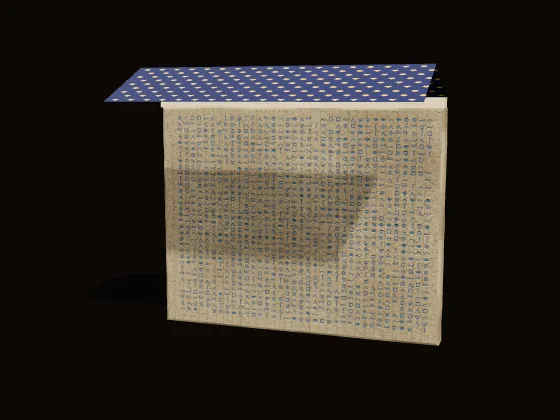 Museum rendition · not a photographThe Pyramid Texts of UnasTexts & Tablets · The Bronze Age · Carved c. 2350 BCE (end of the 5th Dynasty)The oldest large body of religious writing in the world: 283 spells carved and painted blue on the walls of a king's burial chambers under a ceiling of stars. They were…
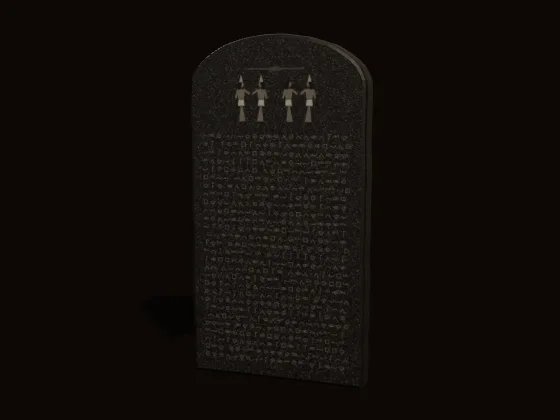 Museum rendition · not a photographThe Merneptah SteleTexts & Tablets · The Bronze Age · c. 1208 BCEA pharaoh's granite hymn of victory, found by Flinders Petrie in 1896. Of its 28 lines, one names Israel, about 3,200 years ago, the earliest certain mention of Israel…
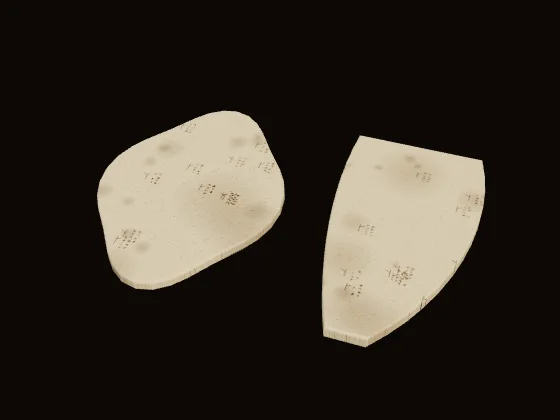 Museum rendition · not a photographThe Oracle Bones of AnyangTexts & Tablets · The Early Iron Age · c. 1250–1050 BCE (late Shang)Turtle shells and cattle shoulder-blades that Shang kings had cracked in fire to put questions to their ancestors, then had the questions and answers carved beside the…
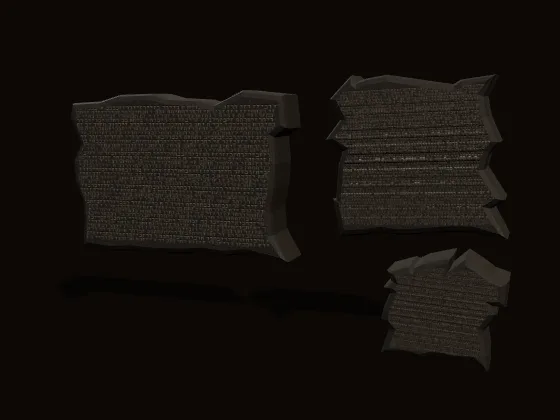 Museum rendition · not a photographThe Tel Dan SteleTexts & Tablets · The Early Iron Age · Late 9th century BCEThree basalt fragments of an Aramaean king's boast, dug up in 1993–94, naming a king of Israel and bytdwd, the 'House of David'. The first mention of David outside the…
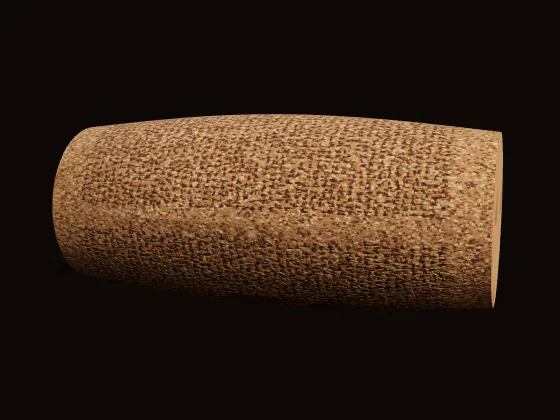 Museum rendition · not a photographThe Cyrus CylinderTexts & Tablets · The Axial Age · After 539 BCEA clay barrel inscribed in Babylonian cuneiform after Cyrus of Persia took Babylon. It praises Cyrus as Marduk's chosen king and records the return of gods and peoples to…
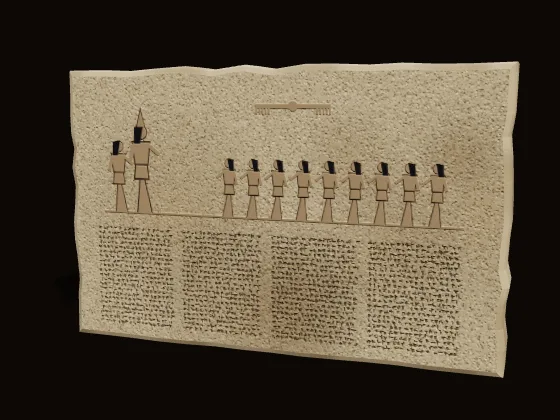 Museum rendition · not a photographThe Behistun InscriptionTexts & Tablets · The Axial Age · c. 520 BCEDarius the Great's account of how he seized the Persian throne, carved about 60 metres up a cliff in Old Persian, Elamite and Babylonian, beneath a relief of the king and…
The Piprahwa RelicsRelics & Sacred Objects · The Axial Age · Stupa deposit c. 3rd–2nd century BCE or earlier (debated)Bone fragments, a soapstone urn and some 1,800 gems dug from a stupa in 1898 by a British estate manager. The urn's inscription says the shrine holds relics of the…
 Museum rendition · not a photographThe Rosetta StoneTexts & Tablets · The Axial Age · 196 BCEA priestly decree honouring the boy-king Ptolemy V, carved in hieroglyphs, Demotic and Greek. Found by French soldiers in 1799, taken by the British in 1801, and used by…
The Sacred Tooth RelicRelics & Sacred Objects · Late Antiquity · In Sri Lanka since the 4th century CE (tradition)The Buddha's tooth, smuggled to Sri Lanka in a princess's hair according to the chronicle, carried in procession by elephants each year. For a thousand years it was the…
 Museum rendition · not a photographThe Holy Lance (“Spear of Destiny”)Relics & Sacred Objects · Late Antiquity · Vienna lance: early medieval (c. 7th–8th century)One Gospel sentence, four rival spearheads, and a 1970s occult myth. The Habsburg lance's gold sleeve reads LANCEA ET CLAVVS DOMINI, but metallurgy dates the blade…
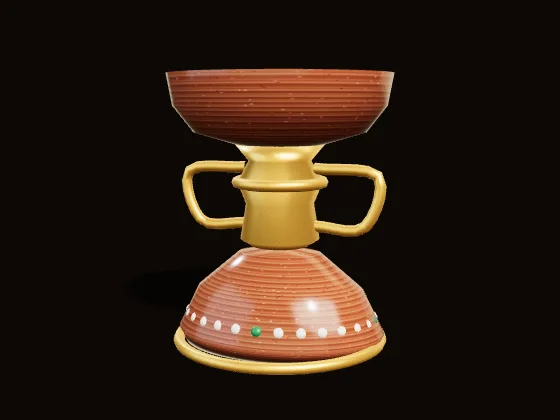 Museum rendition · not a photographThe Holy GrailRelics & Sacred Objects · The High Medieval · Legend from c. 1190 (Chrétien de Troyes)The Gospels mention a cup and say nothing of its fate. The Grail was born in French romance around 1190. Valencia's agate cup, Genoa's glass dish and León's onyx chalice…
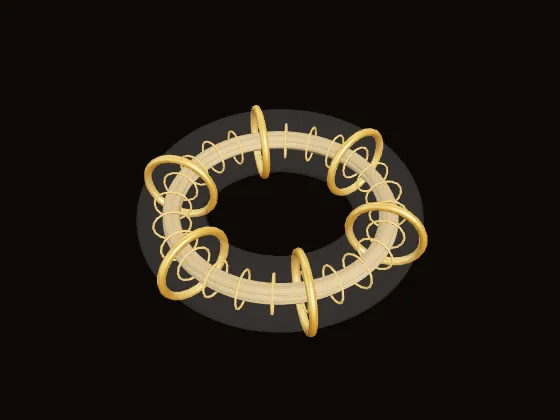 Museum rendition · not a photographThe Crown of ThornsRelics & Sacred Objects · The High Medieval · Documented from 1238 (Paris); earlier history by tradition; never datedA ring of bundled rushes bound with gold thread, with no thorns left on it, for which Saint Louis paid almost half his annual revenue and built the Sainte-Chapelle.…
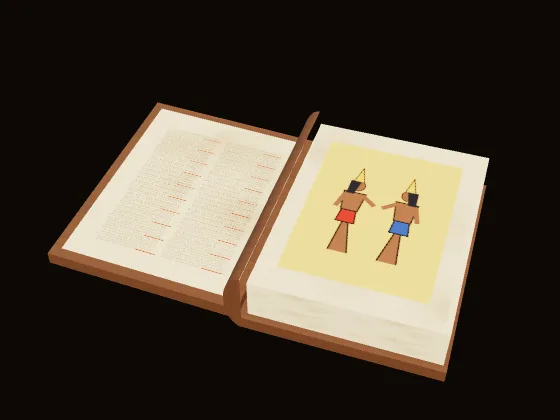 Museum rendition · not a photographThe Kebra NagastManuscripts & Codices · The High Medieval · Compiled c. 1314–1322 CE; surviving manuscripts mostly laterEthiopia's 'Glory of the Kings': how the Queen of Sheba visited Solomon, bore his son Menelik, and how Menelik brought the Ark of the Covenant to Aksum. It gave the…
Comparative themes
Why nearly every people who kept records remembers the world ending in water — the Mesopotamian lineage from Ziusudra to Utnapishtim, its relationship…
Creation & the First OrderHow the world began, told side by side: the watery chaos of Tiamat, Nun, and tehom; the combat myth (chaoskampf) in which Marduk, Baal, and Zeus win…
Journeys to the UnderworldThe descent to the land of the dead — one of the oldest and most widespread of all sacred stories — and what a civilization reveals when it weighs its…
The Great GoddessThe divine feminine — and the modern myth built on top of it. The goddesses we can actually document (Inanna/Ishtar, Isis, Asherah and the ‘Yahweh and…
The End of DaysHow the world ends — and the deep divide between the line and the wheel. The Qumran War Scroll and the apocalyptic mind; the Persian blueprint…
Sacrifice & the ScapegoatThe gift of blood — one of the most universal and most troubling of religious acts. What sacrifice was (korban, ‘drawing near’; yajna into fire…
Visit this theme’s alcove in the Museum (beta) →
From The Divine Archives · https://getconexto.com/chapters/ch49.html · a comparative library of the sacred.